
Lawsuit Loans vs Personal Loans: The Definitive Guide to Choosing the Right Financial Option
- May 6, 2026
Waiting on a legal settlement can create intense financial pressure. Whether you are dealing with medical bills after an accident or lost wages from an injury, life’s expenses do not stop because your case is still in litigation. This reality leads many plaintiffs to explore borrowing options to cover daily needs while waiting for justice.
Two of the most discussed financial supports in this situation are lawsuit loans and personal loans. Although both provide access to money, they operate very differently in terms of approval criteria, cost structures, risks, and repayment obligations. This guide explains everything you need to understand before making one of the most important financial decisions you’ll face during litigation.
What Are Lawsuit Loans and How Do They Work
A lawsuit loan, also referred to as pre‑settlement funding or settlement advance, offers plaintiffs cash while they wait for a lawsuit to settle. These advances are typically non‑recourse, meaning repayment is required only if the case resolves in your favor. If your lawsuit is lost, you generally owe nothing back.
Pre‑settlement funding companies evaluate your case based on legal merits and expected recovery, not your income or credit history. This makes them accessible to plaintiffs who may lack strong credit or income verification but have a potentially strong legal claim.
Funding Amounts and Approval
Most lawsuit loan providers will advance a percentage of the expected settlement amount, often between 10% and 50% of your net settlement value, depending on case strength and anticipated outcome. Approval can sometimes occur within a few days, especially if your attorney is involved in the process.
Although the money may provide immediate relief, it is crucial to understand that these advances are not typical loans and carry costs that can significantly reduce your final settlement proceeds.
True Cost of Lawsuit Loans
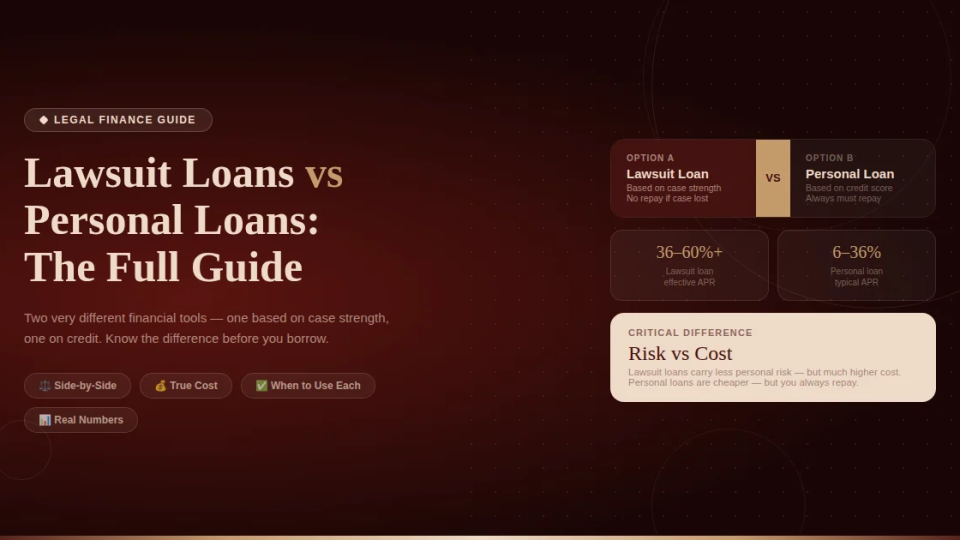
The biggest issue with lawsuit loans is their cost. Rates for pre‑settlement funding are expressed as a monthly funding fee rather than a traditional interest rate, and they are usually much higher than conventional loans. Many companies charge 2% to 5% per month, which equates to roughly 27% to 60% APR or higher due to compounding if the case takes a long time.
For example:
- A $10,000 advance with 3% monthly compounded fees can grow to more than $14,000 in one year and over $20,000 in two years.
- According to industry averages, lawsuit loan APRs often fall between 36% and 60%, significantly more than traditional borrowing.
These costs can seriously erode a plaintiff’s recovery and should be carefully weighed against the benefit of immediate access to cash.
What Are Personal Loans and How Do They Work
A personal loan is a traditional unsecured loan you can get from a bank, credit union, or online lender. Unlike lawsuit loans, personal loans rely on your credit score, income stability, and debt‑to‑income ratio to determine approval and interest rates. You receive a lump sum and repay it in fixed monthly payments over a defined loan term, usually 2 :7 years.
Personal loans are flexible and can be used for virtually any purpose including emergency expenses, debt consolidation, and covering costs while awaiting a settlement.
Typical Personal Loan Rates
Interest rates for personal loans vary widely depending on the lender, your credit profile, and broader economic conditions. As of mid‑2025, the average personal loan rate in the United States was about 26.51% APR, with rates ranging from as low as 5.99% up to nearly 295% in some cases, though most lenders cap rates below 36%.
This wide range reflects the fact that personal loan rates are highly dependent on individual creditworthiness. Good credit generally qualifies for lower rates, while poor credit leads to much higher APRs.
Side‑by‑Side Comparison: Lawsuit Loans vs Personal Loans
Feature | Lawsuit Loans | Personal Loans |
Basis of Approval | Case strength | Credit score, income |
Repayment Required? | Only if case wins | Always |
Risk to Borrower | Lower personal financial risk | Higher obligation risk |
Typical Cost | Very high effective APR | Moderate to high APR |
Credit Impact | No direct impact on credit | Affects credit history |
Speed to Access Funds | Days | Days to weeks |
Advantages of Lawsuit Loans
Despite the high cost, lawsuit loans offer several benefits:
- No repayment if the lawsuit is lost: You don’t owe if the case fails.
- No credit or income checks: Qualification depends on case merit, not financial history.
- Quick access to cash: Often within a few days when documentation is complete.
- Can support daily expenses and legal costs: This liquidity can be critical for plaintiffs who are unable to work.
For injured plaintiffs with limited access to other forms of credit, these features can make lawsuit funding a lifeline despite the high cost.
Disadvantages of Lawsuit Loans
The disadvantages of lawsuit loans are significant and should be fully understood
- High effective cost due to fees: Monthly funding fees compound and can dramatically reduce your settlement.
- Lack of regulation: These advances are not subject to the same consumer protections as traditional loans.
- Repayment eats into your recovery: Because fees accrue until settlement, the longer your case takes, the more expensive the advance becomes.
- Not suitable for weak cases: Approval is based on perceived likelihood of settlement.
In some scenarios, plaintiffs may end up repaying as much as double the advance or more, which can leave little net gain from their legal victory.
Advantages of Personal Loans
Personal loans have advantages that appeal to many borrowers:
- More predictable cost structure: Fixed interest rates and monthly payments make budgeting easier.
- Lower average interest rates: Even though personal loan APRs vary, they are often lower than lawsuit funding costs for comparable amounts.
- Flexible use of funds: Borrowers can use personal loan money for anything, including daily expenses, legal costs, or debt consolidation.
- Helps build credit history: Repaying on time can improve a borrower’s credit profile.
A survey of personal loan borrowers showed that debt consolidation and large expenses are common reasons for borrowing, and most borrowers rated APR as their top cost concern.
Disadvantages of Personal Loans
Personal loans also come with important limitations:
- Mandatory repayment: You must repay regardless of how your lawsuit turns out.
- Credit dependent: Lower credit scores may lead to higher rates or denial.
- Potential negative credit impact: Late or missed payments can significantly hurt credit.
Moreover, if you are in financial distress due to injury and income loss, qualifying for a personal loan can be difficult, making lawsuit loans or other options more appealing despite their cost.
When Lawsuit Loans Make Sense
Lawsuit loans may be reasonable in specific situations:
- You lack other cash sources and are unable to cover essential expenses.
- You have a strong case with a high likelihood of settlement.
- You do not qualify for traditional credit due to low income or poor credit scores.
In these situations, the ability to get funds without monthly repayment obligations can help you survive financially while pursuing justice.
When Personal Loans Are Better
Personal loans tend to be better when:
- You have stable income and good credit.
- You want predictable repayment costs and lower long‑term expense.
- You need flexibility in how funds are used.
- Your financial situation is not in crisis.
If you can manage steady repayments, personal loans are often more affordable and far less risky long term than lawsuit advances.
Legal and Financial Considerations
Before choosing either option, consider the following:
- Read the agreement carefully: Especially for lawsuit advances, where hidden fees and compounding terms can be confusing.
- Understand the true cost: Ask for a detailed payoff schedule for each scenario.
- Consult professionals: Attorneys and financial planners can help you assess which option suits your case and personal finances.
Unlike regulated consumer loans, lawsuit funding operates in a largely unregulated space, meaning terms vary wildly between providers and can contain hidden fees or confusing language.
FAQs
Can you take both a lawsuit loan and a personal loan at the same time?
Yes, but doing so increases your financial obligations. Using multiple loan types requires careful planning to avoid overwhelming debt.
Does a lawsuit loan affect my settlement negotiations?
Not directly, but because you owe fees at settlement, the amount you receive in hand is reduced.
What is the average lawsuit loan cost compared to personal loans?
Lawsuit funding often has APRs above 30% and can exceed 60% due to compounding, while personal loans typically range from 5% to 36% depending on credit.
Are there alternatives to lawsuit loans?
Yes, such as insurance payouts, disability benefits, or borrowing from family before taking high‑cost funding.
Is pre‑settlement funding regulated?
Lawsuit funding lacks uniform federal regulation and varies by state, making transparency essential.
Final Thoughts
Lawsuit loans and personal loans are two very different financial tools, each with distinct advantages and drawbacks. Lawsuit funding offers immediate cash without credit checks or required monthly payments, making it a viable fallback if you lack other options. However, it comes with high effective costs and risks that can substantially reduce your settlement. Personal loans, while requiring credit checks and consistent repayment, usually offer lower cost and more predictable repayment obligations.
The right choice depends on your personal financial situation, credit profile, and legal needs. Carefully weigh the costs, understand the terms, and consult advisors to choose the option that protects both your short‑term needs and long‑term financial health.